The False Finish Line: Reclaiming a Generation from Big Tech
Two landmark verdicts won't save our children. Only we can do that—starting at the dinner table and finishing at the Capitol. Growing Up Together is the roadmap.
Launching Summer 2026 • Early readers get first access
We are building a movement, and it starts with understanding where families stand right now. Take two minutes. Your answers are anonymous and will help shape the national conversation.
Your voice is part of this. The conversation has started.
Stay in the loop.
Get updates as the movement grows — new resources, launch dates, and ways to get involved.

For four decades, Dr. Rod Wilson has helped organizations and communities navigate the conversations others are afraid to have. As a nationally recognized communications strategist and government affairs expert, he has conducted hundreds of focus groups and media workshops, helped establish over 200 businesses and nonprofits, and advised institutions at every level—from neighborhood coalitions to federal policy.
He serves on the Advisory Board of the Drucker School of Management at Claremont Graduate University, where Peter Drucker himself taught that a functioning society is as essential as the air we breathe. Rod took that lesson to heart.
Now he is turning forty years of experience toward the most urgent conversation of our time: how we raise the next generation in a world that was not designed with their well-being in mind.
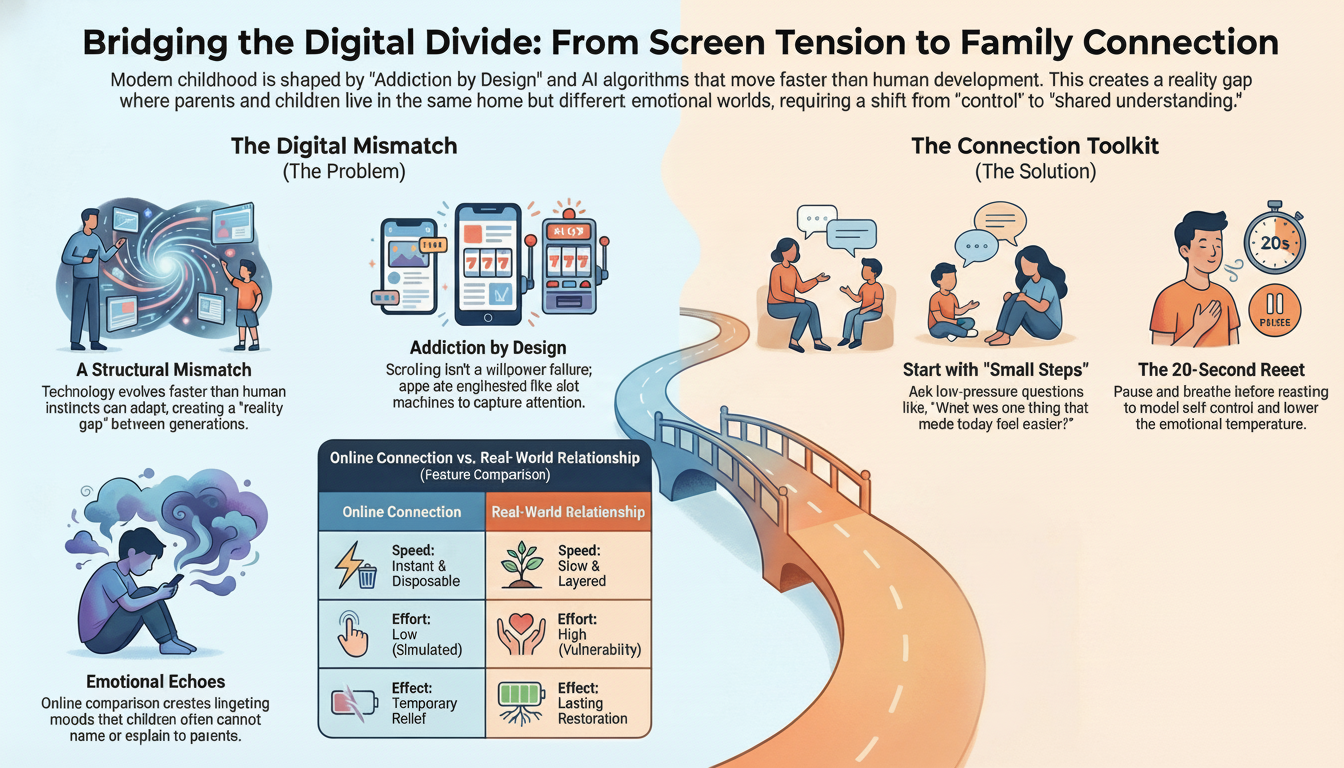
This is not another book about screen time limits or social media bans. It is a book about what comes after the verdict, after the fine, after the outrage fades. It is about what happens when families stop reacting and start building.
Growing Up Together argues that the path forward begins with conversation—not legislation. From the kitchen table to the PTA to City Hall to Congress, it maps a clear escalation that puts power back where it belongs: in the hands of families and communities.
The book is paired with Make the Moments Matter—a guided card deck that gives families a practical way to start real conversations, in any moment, on any day. It also introduces the Family GPT, a private AI-powered tool built around your family’s own values and boundaries, designed to help you navigate the digital world together.
“A human being must have a functioning society just as he must have air to breathe.”
Have an early copy? Share your thoughts and we’ll feature them here.
Every lesson in this book was earned the hard way—in living rooms, boardrooms, and communities across America. These are not theories. They are truths.
You do not need permission. You do not need a title. You need a room, a few people who care, and something to say. Here are the key themes and ready-to-use language for every setting.
The issue is not the device. It is that we stopped talking to each other about what the device is doing to our families. Every community conversation should start here.
Bans and fines make headlines. They do not change behavior. Real change requires a society that agrees on what it is willing to tolerate—and that starts with us, not Congress.
Every proposal is about restriction. Nobody is talking about what we give young people instead. Conversation, critical thinking, and community are the replacement.
MADD, John Walsh, Erin Brockovich—every national movement started with one person who refused to accept the status quo. You can be that person in your community.
Dinner table to church to PTA to City Hall to Congress. That is the path. Old school. Neighbor to neighbor. Face to face. This is how societies have always changed.
Click to expand. Make these your own.
Opens a discussion at a PTA meeting, parent night, or school board session. About 90 seconds.
This affects every family in this room. This week, two juries—one in New Mexico, one in Los Angeles—found social media companies liable for harming children. The jury in LA found they acted with malice. These are historic verdicts. But verdicts do not raise our children. We do.
Ninety-five percent of our teenagers are on social media, averaging nearly five hours a day. Depression among young people is up 33 percent. The suicide rate for girls is up 65 percent. And the companies that built these platforms? Their own executives would not let their children use them.
The question is simple: when was the last time we sat down with our children and talked—really talked—about what they see online and how it is shaping who they are becoming? That conversation is the beginning. What happens next is up to all of us.
For a church announcement, small group, or community of faith. Adjust the language for your tradition.
Our families are in trouble. Not because of a lack of faith, but because something has come into our homes that we were not prepared for. The average teenager spends more time each day on social media than in school, at the dinner table, and in this building combined.
We teach our young people values. But the algorithm is teaching them something else—and it has their attention for five hours a day. The companies that built these platforms knew what they were doing. Two juries just confirmed it.
The answer starts here, in community. Not with legislation, but with conversation. If every family in this room committed to one honest conversation this week about what their children are encountering online, that would be the beginning of something powerful. A functioning society starts with functioning families. Let us start with ours.
For coaches, league gatherings, or youth organization events. Short, direct, action-oriented.
We spend a lot of time teaching these kids how to compete, how to work as a team, how to handle winning and losing. But there is a competition happening off the field that we are losing badly.
Social media platforms were designed to capture attention. They are winning. Our kids are averaging five hours a day on these apps. One in five high school students has seriously considered ending their own life. These are not statistics. These are our players, our kids, sitting right out there.
We are already a community. We already show up for each other. Talk to your kids about what is happening online. Not as a lecture. As a conversation. If you are not sure how to start, there are resources that can help.
For public comment periods, town halls, or meetings with elected officials.
This week, juries in two states held social media companies liable for harming children. A New Mexico jury awarded $375 million. A Los Angeles jury found Meta and YouTube acted with malice and awarded $6 million in a bellwether case representing 2,000 more families. Both companies have said they will appeal.
While those appeals play out—which could take years—our children cannot wait. We are facing a youth mental health crisis driven in part by platforms that were engineered to be addictive. Families are already coming together to address this through conversation and community action. They need to know their local leaders hear them.
No audience needed. Just one other parent, one conversation.
Did you see those verdicts against Meta and YouTube this week? Two juries found them liable for harming kids. It got me thinking about how much time our kids spend on these platforms and whether we really know what they are seeing.
I have been trying to have more conversations at home about it. Not taking the phone away—just talking. It is harder than I expected. But something stuck with me: the problem is not the technology, it is the silence. If we are not talking to our kids about what they see online, the algorithm is raising them for us.
Would you want to get a few families together and just talk about it? Nothing formal. Just a conversation.
Every movement needs people who are willing to go first. If you want to organize your community—whether that is a neighborhood gathering, a PTA conversation, a church group, or something bigger—sign up here. We will give you the tools, the talking points, and the support to make it happen.
We will be in touch with everything you need to get started in your community. The village just got stronger.
Be among the first to read Growing Up Together before it hits shelves. Reserve your advance digital copy today.
No charge today. You’ll be notified when your order is ready. Your information is never shared.
Launching Summer 2026. Early readers receive their copies before anyone else—plus exclusive access to the Growing Up Together community.
Families don't struggle because they never reach understanding. They struggle because understanding fades. The Family GPT is a private, family-defined reference — a place to capture the language, values, boundaries, and insights your family has already worked to build, so they don't disappear when things get hard. Think of it as memory, not authority.
Your Family. Your Data. Completely Private.
When you create your own Family GPT, it belongs to you and only you. No one else can see it, access it, or view your conversations. Your family's details, challenges, and discussions are never shared, never stored on our servers, and never used to train AI models. It is as private as the conversation at your own kitchen table.
You decide what goes in. You decide who has access. You can delete it at any time. This is your family's tool — built by you, for you, and seen by no one else.
Give it a try with the Mitchell family below — this is a demo to show you how it works. Meet the family, then ask a question. Click one of the sample scenarios or type your own. When you are ready, the book shows you step-by-step how to create a completely private Family GPT for your family.
Makes hundreds of decisions at work every day. Involved in some kids' activities but can't always be there.
The glue of the family. Constantly worried about the kids. Tries to track their social media but challenged by technology the kids use to run circles around her.
Active, athletic, popular, opinionated. Slightly spoiled. Challenges authority regularly. Pushes boundaries.
Quiet, reserved. More of an isolationist. Doesn't easily communicate face-to-face. Prefers smartphone and social media over in-person conversation.
The book walks you through creating your own — completely private, completely yours. No one else sees your family's information. Customize it for your own members, dynamics, and challenges. It stays between you and your family, forever.
Get the Book to Build Your Private Family GPTGrowing Up Together is written for parents, grandparents, and caregivers of children of all ages — but especially families with kids between 8 and 18. The Make the Moments Matter cards are designed so that everyone at the table, from age 6 to 86, can participate.
The advance copy is a digital ebook. A physical edition is planned for later in 2026. The Make the Moments Matter card deck is a physical printed deck that ships to your door, plus a digital companion app you can access anywhere.
Yes. The card deck and digital app are available as a standalone purchase for $19.99. However, the book provides the foundation — the "why" behind each card — and we recommend experiencing both together.
We are launching in Summer 2026. Early readers who sign up now will receive their copies before the general public, plus exclusive access to the Growing Up Together community.
The Family GPT is a private, AI-powered tool that lives on your device and reflects your family's values, boundaries, and communication style. It is not a chatbot that gives advice — it is a mirror that helps your family stay aligned during difficult conversations. No one else can see it or access it. Your data is never stored or shared.
Most books tell you what is wrong. This one gives you what to do about it — starting tonight. It comes with practical tools: conversation cards, a private AI assistant, a community framework, and a clear escalation path from your dinner table to the halls of Congress. It is a book, a toolkit, and a movement.